

In a hangar on the floor of Rogers Dry Lake, eight portraits stood in a row, each flanked by wreaths — a base built on testing the limits of flight pausing to count the cost of it.
A community gathers
On Monday evening, the 412th Test Wing hosted a memorial at Edwards Air Force Base for the eight people killed two weeks earlier, drawing families, fellow airmen and the wider Antelope Valley community, Bakersfield Now reported. A military flyover closed the ceremony. "This evening, we gather to honor and remember our teammates who sacrificially gave their lives for our nation on the morning of June 15, 2026," said wing chaplain Timothy Sessions. Lt. Col. James McDonald, who commands the 419th Flight Test Squadron at the heart of the mission, offered no easy comfort: "No words can explain a loss this profound."
What happened on June 15
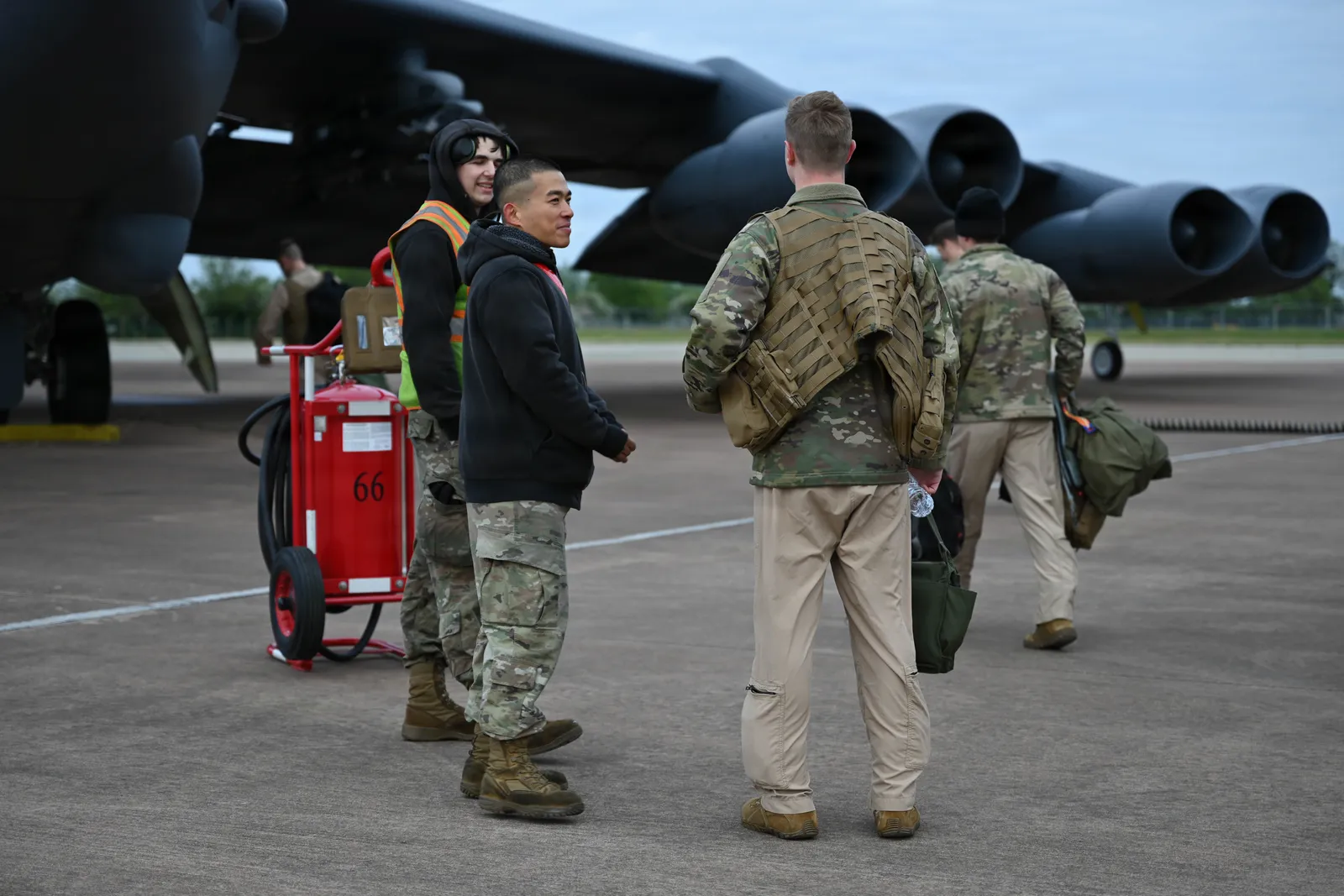
Shortly after takeoff on the morning of June 15, a Boeing B-52H Stratofortress crashed near the runway and caught fire, Stars and Stripes reported. The aircraft was flying in support of the Air Force's program to modernize the B-52's radar. A deputy commander of the 412th Test Wing told reporters it was "immediately clear" the crash was not survivable, CBS News reported. Edwards, on the floor of Rogers Dry Lake in Kern County about 100 miles north of Los Angeles, is the Air Force's primary site for developmental flight testing — the place where new aircraft and upgrades are proven before entering service.
The eight who were lost
The Air Force released the names of all eight. They spanned the test community — active-duty officers, a civilian engineer, retired military flying for Boeing, and a contractor:
- Lt. Col. Gabriel Estrella, weapon systems officer, Air Force Operational Test and Evaluation Center
- Maj. Alexander Davis, weapon systems officer, 419th Flight Test Squadron, of Lancaster
- Maj. Robert Dee, pilot, 419th Flight Test Squadron
- Maj. Brad Hovey, pilot, 419th Flight Test Squadron
- Jeromy Smith, flight-test engineer, 419th Flight Test Squadron, of Rosamond
- Christopher Rischar, flight-test engineer and JT4 contractor, of Lancaster
- Retired Lt. Col. Miles Middleton, Boeing pilot, of Tehachapi
- Col. Gregory Watson, weapon systems officer, Boeing and Air Force reservist
"They were dedicated professionals, beloved family members and irreplaceable teammates," wing commander Col. Thomas Tauer said. Boeing, which employed two of the men, said their loss "is deeply felt across our teams, and our hearts remain with their families."
An investigation, and a heritage of risk
The Air Force has convened an Accident Investigation Board, a process officials say could take months; no cause has been determined, and the service has not speculated publicly about contributing factors. Flight-test operations at Edwards resumed on June 22, and officials said they did not expect restrictions on the rest of the B-52 fleet. It was the first fatal B-52 crash in years and, by several accounts, the deadliest since a 1982 accident. Edwards has long been the proving ground of American aviation — where the sound barrier was first broken, and where the work of staying ahead has always carried risk. The wreaths and the flyover were an acknowledgment that the cost is sometimes paid all at once, and that some mornings in the Mojave do not end the way they began.