
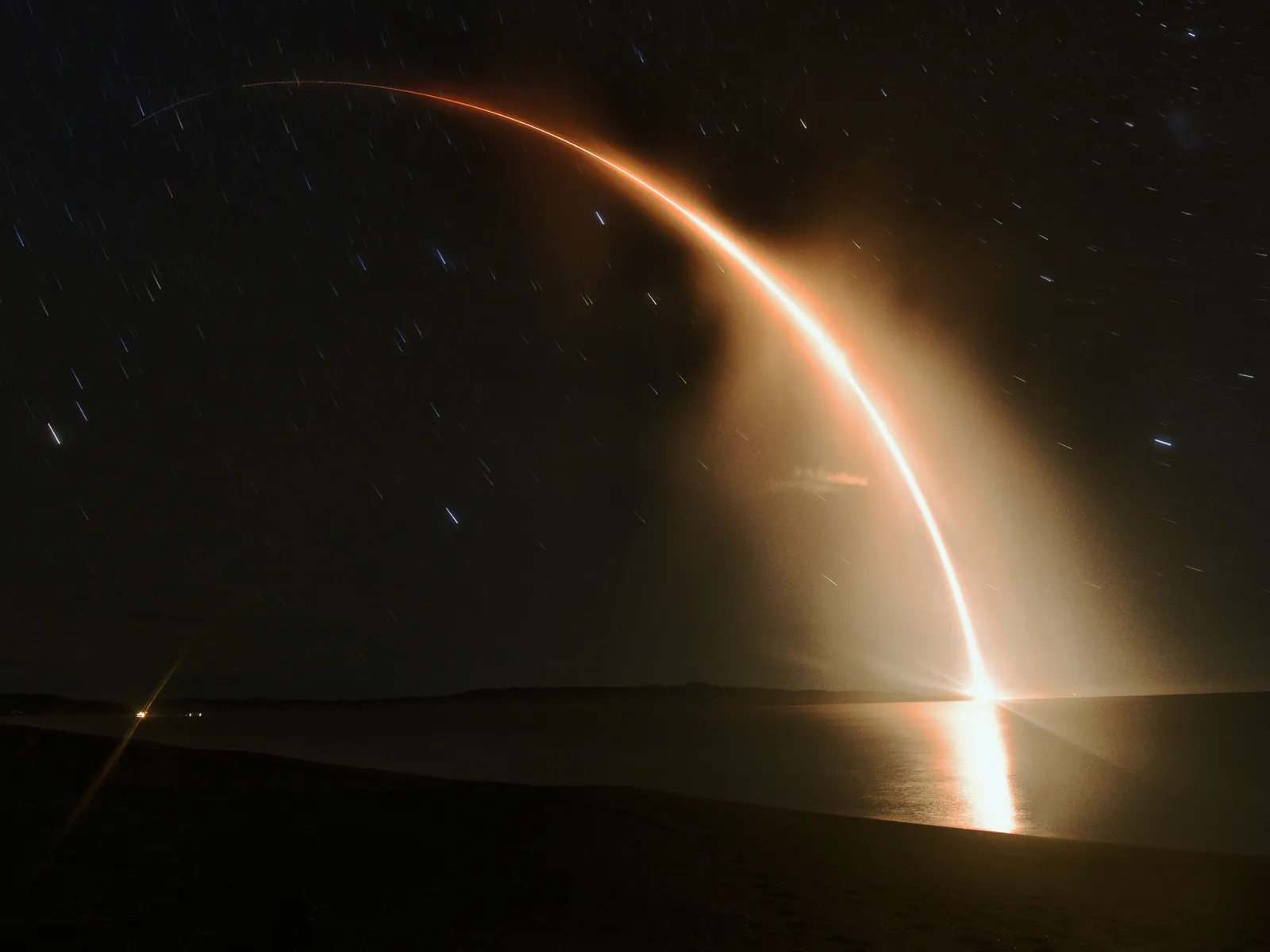
A California rocket company best known for putting other people's satellites into orbit just moved to build a satellite network of its own.
An $8 billion leap
Rocket Lab said Monday it has agreed to acquire Iridium Communications in a deal valued at about $8 billion — its boldest move since founder Sir Peter Beck took the firm public in 2021. If approved, the transaction would turn the Long Beach launch provider into a vertically integrated communications company running its own global network, putting it in direct competition with SpaceX's Starlink and Amazon's Project Kuiper. Iridium shareholders would receive $54 a share — $27 in cash plus Rocket Lab stock — a roughly 24 percent premium, with about $3.6 billion in debt financing from Deutsche Bank and Wells Fargo. The companies expect the deal to close in mid-2027, pending shareholder and regulatory approval.
What Rocket Lab is getting
Iridium brings a constellation of 66 low-Earth-orbit satellites, more than 2.5 million subscribers and — critically — a globally coordinated block of L-band radio spectrum that took decades of international filings to secure and cannot easily be replicated. The McLean, Virginia, company, which reported roughly $870 million in 2025 revenue, serves the U.S. government and military, commercial aviation, global shipping and industrial users in remote regions beyond cellular reach. Unlike Starlink's consumer-broadband model, Iridium specializes in low-bandwidth but highly reliable, mission-critical connectivity — a niche Rocket Lab says it intends to build on, including direct-to-device service that could connect ordinary phones without ground infrastructure.
A Long Beach launch company's ambitions
Rocket Lab has become one of the world's most active commercial launchers; its Electron rocket has flown more than 90 missions and deployed over 200 payloads, and it is developing a larger vehicle, Neutron, that has not yet flown. The company posted record quarterly revenue of $200 million in early 2026, up 64 percent from a year earlier, against a backlog of about $2.2 billion. "This is a defining moment for the space industry," Beck said, citing the marriage of Iridium's "trusted infrastructure and highly sought-after spectrum" with Rocket Lab's launch and manufacturing.
The stakes — and the risks
SpaceX's Starlink remains far larger, with an estimated 10 million-plus subscribers and a constellation of thousands of satellites; Amazon's Kuiper is racing toward commercial service. The combined Rocket Lab-Iridium would not match that scale, but its backers argue Iridium's regulated spectrum and loyal enterprise base offer a defensible niche SpaceX hasn't fully entered. Analysts also flagged real risks: the bank debt adds heavy interest costs to a company still working toward consistent profitability, integrating a mature regulated operator into a fast-growing launch firm is complex, and the year-long path to closing leaves the deal exposed to shifting markets. Investors liked it anyway — Rocket Lab shares jumped sharply on the news and Iridium's rose roughly 24 percent, though the deal is not yet final.