

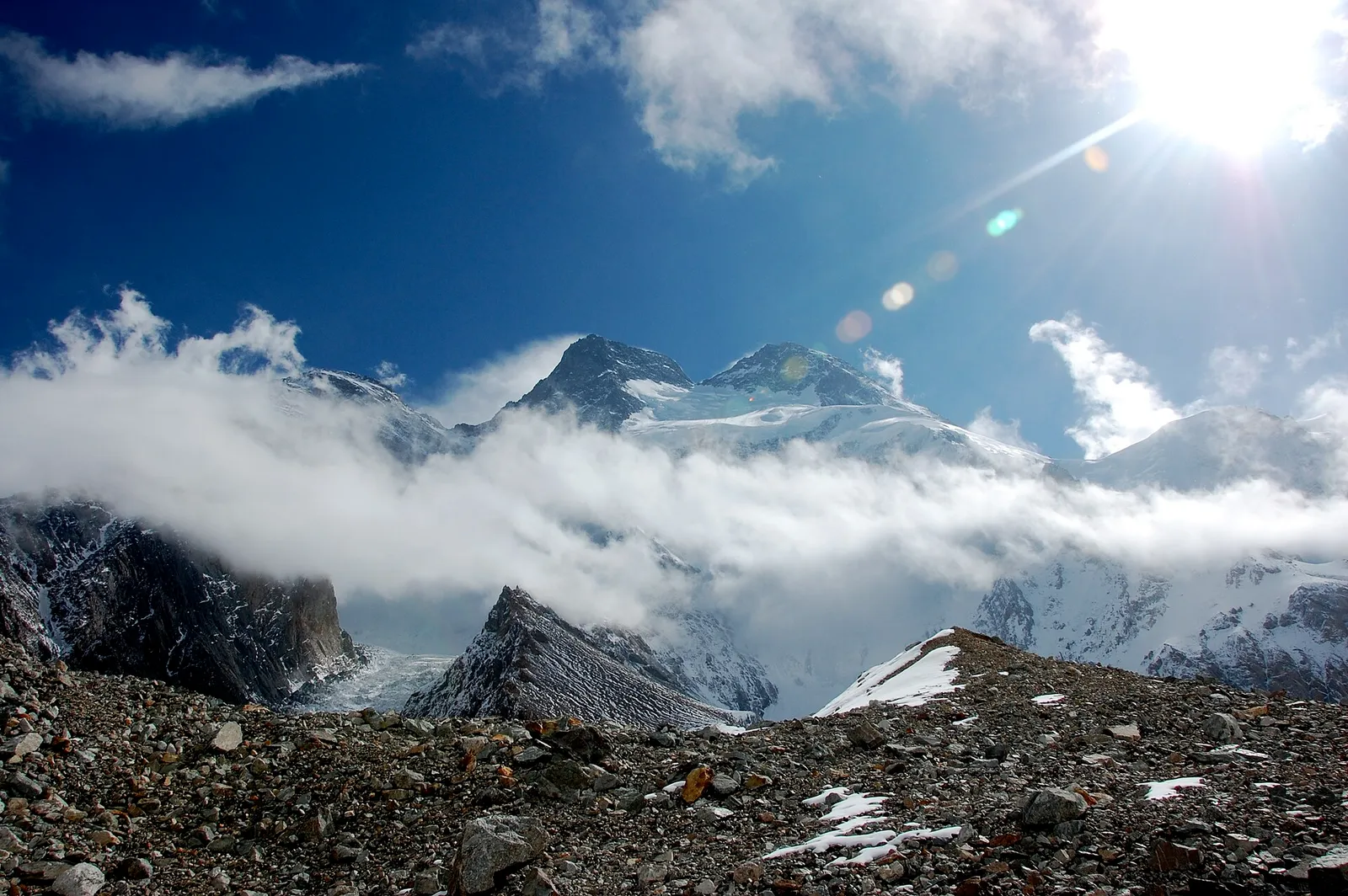
An avalanche swept a ten-person expedition off Broad Peak, the world's twelfth-highest mountain, in Pakistan's Karakoram range on July 30. Two days later the search is still going, and the arithmetic of it is grim and slightly unstable.
Four bodies have been located, Al Jazeera reported, of which three have been recovered, identified and flown to the combined military hospital in Skardu by Pakistan Army Aviation helicopters, Dawn reported. That is why the count of the missing differs between accounts: Al Jazeera puts it at six, counting the fourth body as found; Dawn puts it at seven, counting only those brought down.
The three named dead are Nadhira Ahmed Abdullah Al Harthy of Oman, Pur Bahadur Gurung of Nepal, and Mallory Geis of the United States. Al Harthy was the first Omani woman to reach the summit of Everest.
Who was on the mountain
The expedition was made up of five Nepali climbers, the Pakistani mountaineer Sohail Sakhi, a Chinese climber named as Wang, Al Harthy, Geis, and two British nationals, a man and a woman, Al Jazeera reported.
Leading it was Nirmal Purja, the Nepali climber widely known as Nims Dai, and he is among those still unaccounted for. Purja holds the record for the fastest ascent of all fourteen of the world's 8,000-meter peaks, which he completed in six months and six days between April and October 2019, and he was part of the first winter ascent of K2 in 2021. He is one of the most recognizable figures in high-altitude mountaineering, which is part of why this accident has traveled well beyond the climbing world.
The search
A three-member civil rescue team led by the mountaineer Sarbaz Khan was flown to Broad Peak base camp, Dawn reported, with the Alpine Club of Pakistan coordinating. Drone footage indicated the presence of additional climbers at the site.
The operation was suspended late Friday because of poor weather and was due to resume on Saturday once conditions improved. A statement quoted by Al Jazeera said that "every possible effort is being made to ensure that helicopter support and all available rescue resources are mobilised at the earliest opportunity, subject to weather and operational conditions."
That sentence describes the constraint precisely. At these altitudes a helicopter's margin is thin in good weather and absent in bad, and a ground search across avalanche debris moves at the speed of people who are themselves short of oxygen. The Karakoram in high summer produces the conditions that cause slides like this one: sun on the snowpack by day, refreezing at night, and slopes that release without warning.
The Gilgit-Baltistan government has offered condolences to the families of the dead and said it will provide assistance, Dawn reported.
What is still unknown
The identity of the fourth body has not been released, and the names of the missing beyond Purja have not been published. Nobody has been reported found alive since the avalanche.
Search at this altitude turns into recovery quickly, and two days is a long time. Pakistani authorities have not said that publicly, and until they do, the operation on Broad Peak is still, formally, a search.