
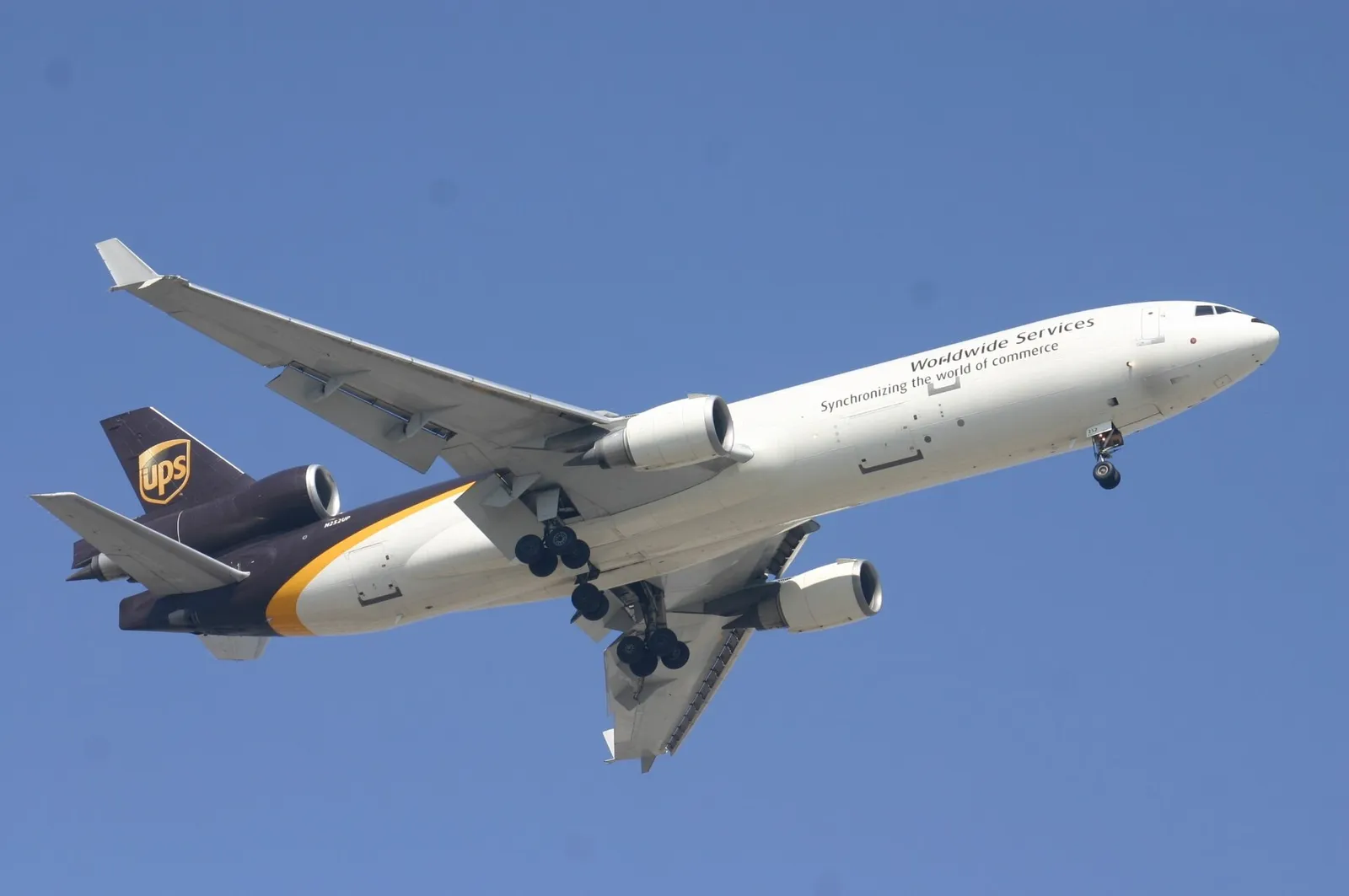
Eight months after a UPS cargo jet went down seconds after takeoff in Louisville, investigators have zeroed in on a part the size of a fist — and on the fact that no one was required to look at it.
The crash
UPS Airlines Flight 2976, a McDonnell Douglas MD-11 freighter bound for Honolulu, lost its left engine during its takeoff roll from Louisville Muhammad Ali International Airport on Nov. 4, 2025, and crashed into an industrial area moments after lifting off. All three crew members were killed, along with people on the ground; the toll reached 15, including one person who died of injuries weeks later, Louisville Public Media reported.
The National Transportation Safety Board has said fatigue cracks were found in a spherical bearing inside the engine's mounting structure — a component that helps hold the engine to the wing. When it failed, the attachment points gave way and the engine separated.
The part no one checked
The finding drawing scrutiny this week is what UPS's maintenance program did, and did not, require. According to documents the NTSB has released, UPS instructed mechanics only to check the bearing assembly for corrosion — not to perform the kind of detailed inspection that might have revealed fatigue cracking. The bearing sits deep within the engine pylon, hard to examine without pulling the engine.
UPS told investigators it saw no need for a tougher inspection because Boeing had issued service letters, in 2008 and 2011, stating that a fracture of that bearing did not pose a flight-safety risk. In other words, the airline followed the manufacturer's assessment — an assessment the NTSB's inquiry now suggests was wrong.
Warnings that came before
Investigators have said Boeing received five earlier reports of the same bearing fracturing on MD-11 and DC-10 aircraft before the Louisville crash. Even so, Boeing had asked the Federal Aviation Administration to lengthen the inspection interval for the related engine-mount lugs — from about 19,900 to 29,200 flight cycles. The accident aircraft had flown 21,043 cycles, below the thresholds that would have triggered the most detailed mandated checks.
At an NTSB hearing in May, Boeing acknowledged that it and the FAA had "misunderstood the risks" tied to the bearing, not appreciating that a fracture could weaken the lugs holding the engine on. Boeing has also told the board that a change to the inspection requirement was warranted — while maintaining that the existing requirements were adequate, a tension the investigation is still working through.
What has changed
Since the crash, the NTSB, Boeing and the FAA have moved toward far more frequent attention to the part: the spherical bearings in MD-11 engine mounts are now to be replaced at much shorter intervals than before. UPS retired the last of its MD-11 fleet in January.
The investigation is not finished. The board is still examining maintenance records, Boeing's communications with regulators, and a broader question the crash has thrown into relief: how a manufacturer's advisory that a part is "no safety risk" can quietly become the reason no one is required to inspect it — until it fails.