

On January 15, 2025, a Falcon 9 sent two commercial landers toward the moon: Firefly Aerospace's Blue Ghost and a lander from the Japanese company ispace. The landers went where they were sent. The rocket's upper stage, having spent its fuel getting them there, was simply left in space.
It has been looping through the region between Earth and the moon ever since, and on Wednesday, in the early hours, it is expected to run out of room, ABC7 reported.
The numbers
The stage should hit at about 5,400 mph, roughly seven times the speed of sound. Benjamin Fernando of Los Alamos National Laboratory estimates the resulting crater at about 90 feet across and 16 feet deep.
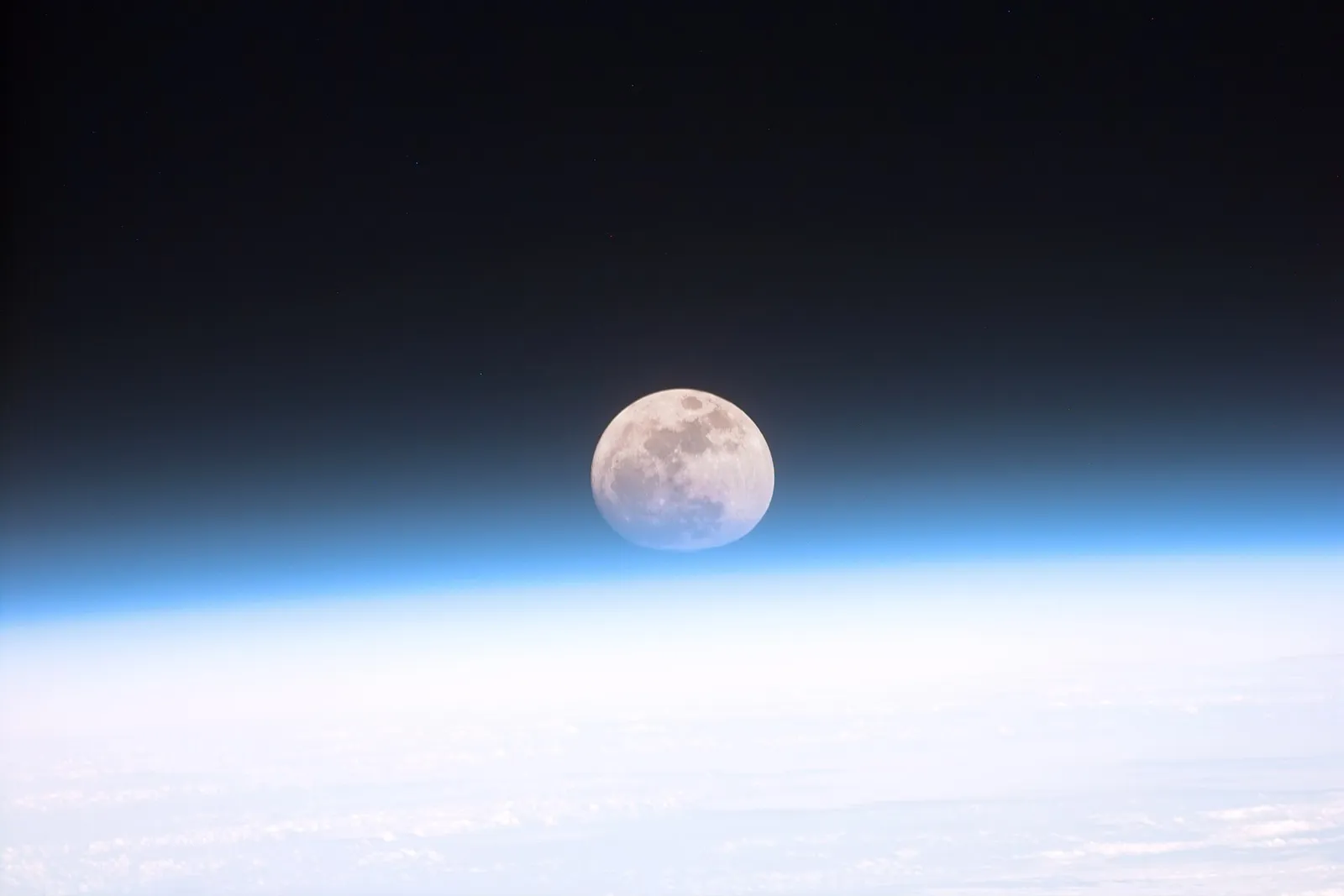
The predicted impact point is on the near side of the moon, near Einstein Crater on the sunlit western limb. That location is unusually convenient: near side means Earth-based instruments have a line of sight, and sunlit means the site can be photographed before and after.
The trajectory work is by Bill Gray, a space tracking analyst who has done this before for derelict objects in cislunar space. A caution that belongs in every story of this kind: predictions for abandoned hardware carry error bars, because a spent stage is a light, hollow object whose path gets nudged by sunlight over months. ABC7's account gives a day rather than a minute, and the sensible way to read that is as the estimate it is.
Who is watching
NASA's Lunar Reconnaissance Orbiter and South Korea's Danuri lunar orbiter will both take before-and-after images of the site.
Danuri gets the better seat. It is due to pass within one to two miles of the rocket about two minutes before impact, which is close enough that the encounter is itself an exercise in orbital prediction.
The scientific value is modest but real. An artificial impactor of known mass, arriving at a known speed at a known place, is a calibration event. Natural impacts give you none of those three things, so a controlled comparison helps refine how researchers locate and size impacts from seismic and imaging data, which matters for any future network of instruments on the surface.
Why there is a rocket stage hitting the moon at all
Because nothing requires anyone to clean up after a deep-space launch.
Rules for disposing of hardware in low Earth orbit have existed for years and are enforced with varying seriousness. The volume between Earth and the moon has no equivalent regime. An upper stage that has completed a trans-lunar injection burn typically has no propellant left to steer itself anywhere in particular, and so it goes wherever the gravity of two bodies takes it, for as long as that takes.
This is not the first time. A Chinese rocket segment struck the far side of the moon in 2022, producing a pair of craters, ABC7 reported, in what was the first known accidental rocket crash into the moon.
Nobody is in danger from Wednesday's impact. The moon has absorbed considerably worse for four billion years. What the event marks is that the traffic between here and there has grown busy enough to leave litter, and that the litter now arrives on a schedule precise enough to point a camera at.