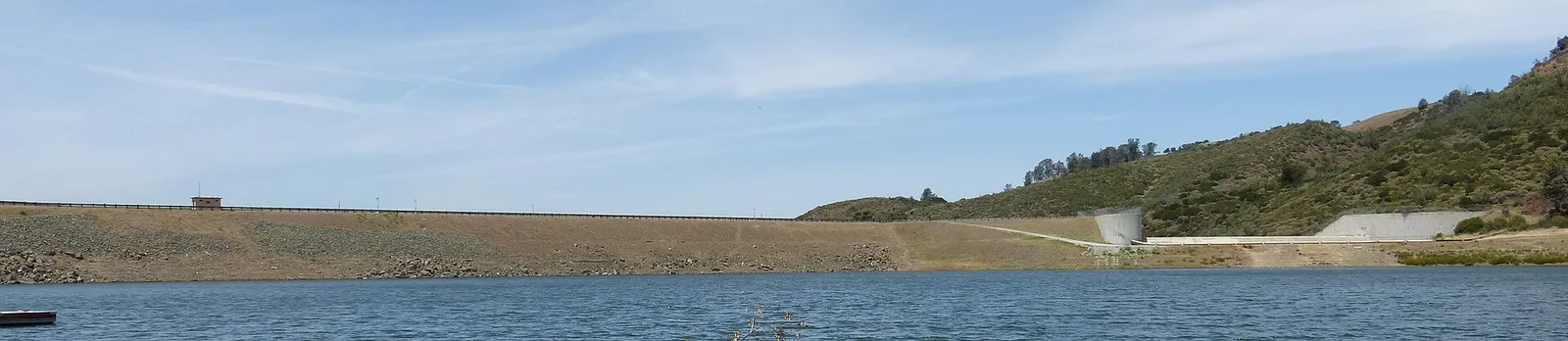
Anderson Reservoir, near Morgan Hill, holds about 90,000 acre-feet when it is full. It has not been anywhere close to full since 2020, and it will not be again until the middle of the next decade.
On July 24, Valley Water's board awarded a $1.88 billion construction contract to the Flatiron Dragados Sukut joint venture to rebuild most of the dam. Work is scheduled to start in early 2027 and to take about seven years.
Why the reservoir was emptied
A stability evaluation in 2011 found that the dam's embankments could become unstable in a very large earthquake, and that a fault rupture beneath the structure could damage the outlet pipes and intake works, the very equipment you would need to control a release. The dam was built in 1950, to standards that predate most of what is now known about how earth-fill dams behave in a strong shake.
In February 2020 the Federal Energy Regulatory Commission directed Valley Water to draw the reservoir down to elevation 488 feet, effective October 1 of that year. It has been held at roughly three percent of capacity since.
That is the part worth sitting with: the regulator's judgment was that the safest version of this dam is one holding almost no water, for a decade and a half, in a county that needs the storage.
What the rebuild involves
This is not a patch. The plan replaces most of the dam and the spillway, installs new high- and low-level outlets, and treats the foundation and seepage controls. The reservoir stays essentially empty throughout construction, with the target for full operation in 2034.
The cost figures do not line up, and that is worth saying plainly
The construction contract is $1.88 billion. Beyond that, published totals diverge: Engineering News-Record's coverage frames the rebuild as a $2.8 billion project, other trade coverage has described a $3.2 billion program, and Valley Water's own project page lists a total cost of $1.77 billion without inflation and $1.97 billion with it.
Some of that gap is definitional: whether a figure covers only the dam retrofit or the wider program of related work, and whether it is stated in current dollars or escalated over a seven-year build. But the range is wide enough that anyone citing a single number for this project should say which one they mean. On a public works job of this size, funded by ratepayers, the definition is not a footnote.
What it costs the county in the meantime
Santa Clara County has spent the drawdown years leaning harder on imported water. Roughly half the water used locally comes from outside the county, and with its largest reservoir offline that dependence continues through construction. Restoring the reservoir is expected to improve supply reliability, support groundwater recharge and restore flood-control capacity on Coyote Creek.
Why Southern California should pay attention
The Bay Area is not the only region with mid-century dams sitting near faults. Aging water infrastructure across California is moving through the same cycle of reevaluation, restriction and expensive reconstruction, including work on major facilities in Los Angeles County.
Anderson is the case study for what that cycle costs when the answer comes back "rebuild it": fourteen years between the finding and the finished dam, a decade of lost storage in the interim, and a price tag that different official and trade sources still describe differently.