Just after 1 a.m. on June 24, 2026, the names of 98 people were read aloud in the dark at a park in Surfside, Florida — one by one, at the hour the building came down five years earlier. Many in the crowd had been there for every anniversary. Some had been inside the tower.
What happened
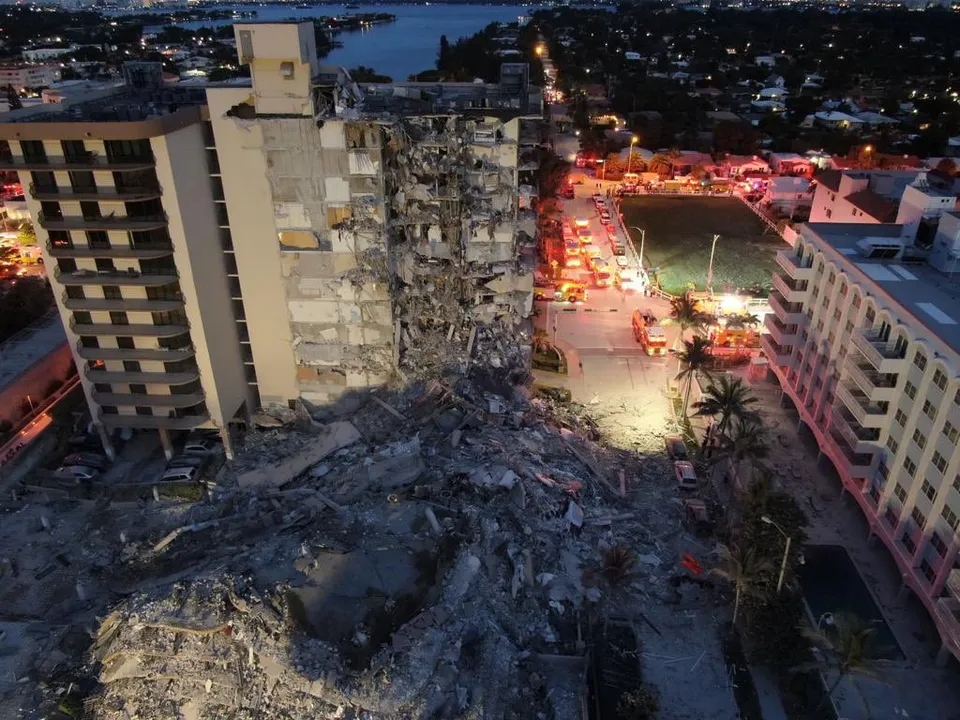
The 12-story Champlain Towers South condominium partially collapsed in the early hours of June 24, 2021, pancaking in seconds and killing 98 people. It remains one of the deadliest non-deliberate building failures in U.S. history.
An investigation that feels unfinished
The federal National Institute of Standards and Technology has spent five years trying to explain why, and the picture its investigators have assembled is one of compounding failures: design deficiencies, deviations from approved plans, decades of corrosion in the building's reinforced concrete, and loads that crept upward over the years. Investigators have pointed to a failure originating at slab-column connections beneath the pool deck as the most likely starting point of the collapse, as the agency's work has detailed.
For many families, the findings have not brought peace. NIST released a significant update only days before the five-year mark — timing some survivors found painful — and relatives have criticized the conclusions as hedged and incomplete, CBS Miami reported. After five years, some say, they still do not feel they have a definitive, accountable answer for why their loved ones died.
The settlement, and the limits of it
A civil settlement of roughly $1.2 billion was approved by a Miami-Dade judge in 2022, less than a year after the collapse, among the largest of its kind, NPR reported at the time. The money was divided among the families of those who died, survivors who were injured, and unit owners who lost their homes. But money, families have said again and again, was never what they were seeking.
A luxury tower on hallowed ground
The beachfront lot where Champlain Towers South stood was sold to a developer, and a new luxury condominium is planned for the site — a prospect that has deepened the grief of those who hoped the ground would be preserved. A permanent memorial on the collapse site has not been built, and plans for it have been scaled back. For now, a wall bearing the 98 names stands at a nearby park as the principal marker.
What endured
One concrete legacy of the disaster is reform: Florida tightened its requirements for inspecting older condominium buildings and for maintaining adequate financial reserves for repairs, changes credited with forcing a reckoning over deferred maintenance across the state's aging towers. It is the kind of change that may save lives in buildings no one has heard of yet.
It cannot, of course, return what was lost in Surfside. Five years on, the families keep gathering in the dark to read the names — proof that the wound has not closed, and a quiet insistence that the 98 not be forgotten.