

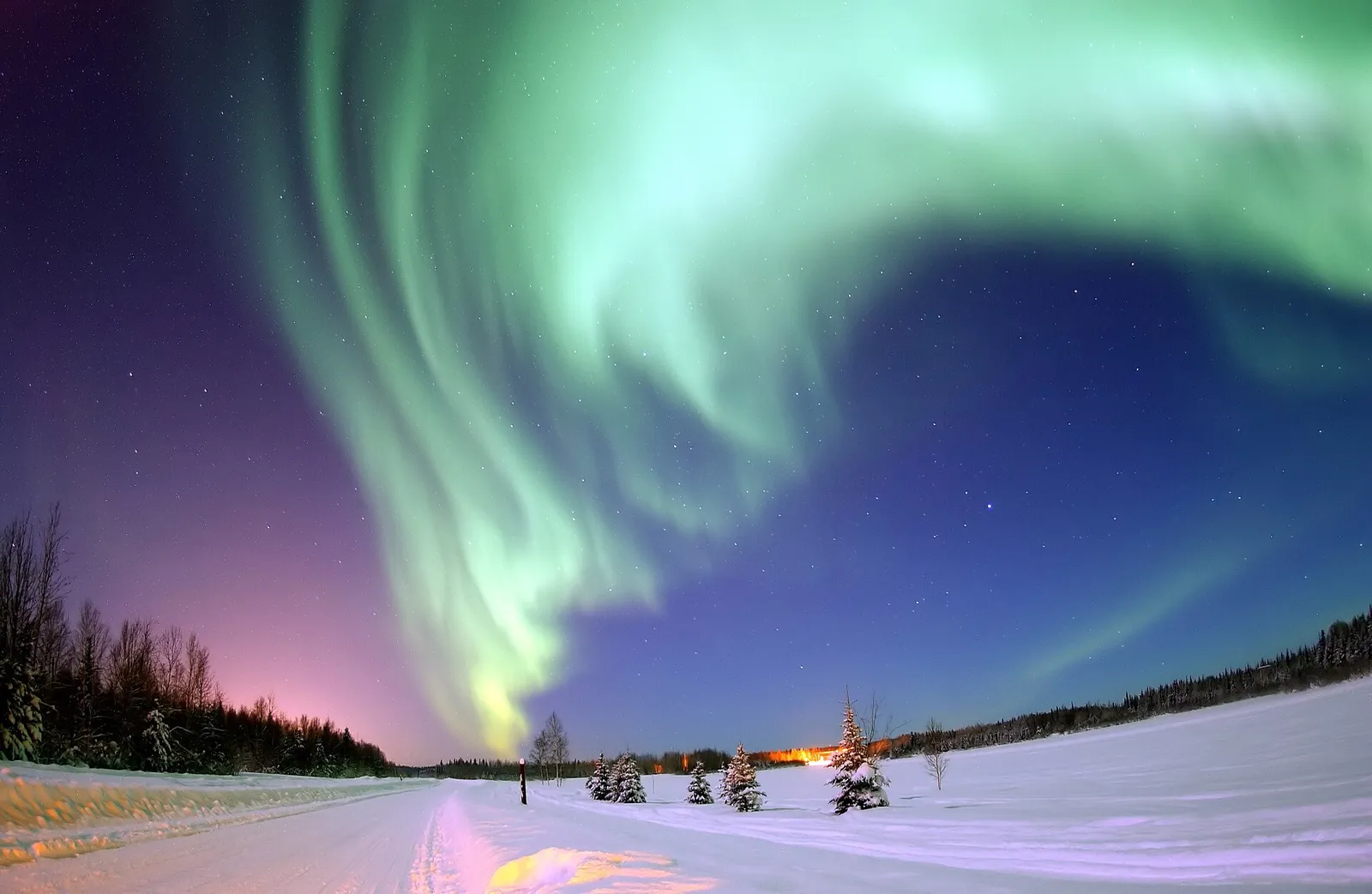
Space weather forecasters are watching the sun this week, and the timing could hardly be better for a holiday: a geomagnetic storm is expected to brush Earth over the July 4 weekend, potentially pushing the northern lights south of where they usually appear.
What's happening
The trigger is a coronal mass ejection — a huge cloud of charged particles flung off the sun by a solar flare in recent days. When that material reaches Earth, it disturbs the planet's magnetic field, and those disturbances are what light up the sky. NOAA's Space Weather Prediction Center is forecasting geomagnetic activity reaching roughly the "G2," or moderate, level around July 3 and 4, with the Kp index — a 0-to-9 scale of how disturbed the magnetic field is — climbing toward the higher middle of the range.
A G2 storm is meaningful but not extreme. It is the kind of event that can nudge the aurora into the northern tier of the country, not the sort that paints the sky over the Sun Belt.
Where you might actually see it
The best odds belong to the far north: Alaska, and near the Canadian border in states like Montana, North Dakota, Minnesota and northern Michigan and Maine. Parts of the Pacific Northwest and the upper Great Lakes could catch a low, greenish glow on the northern horizon if the storm strengthens and skies are dark and clear.
For Southern California, though, the realistic expectation is nothing. Los Angeles sits near 34 degrees north latitude; a G2 storm's aurora generally stays well north of that. Only a far more powerful storm — the rare G4 or G5 — has any chance of being seen this far south, and this forecast does not call for one. It is better to enjoy the fireworks.
A big caveat
Aurora forecasts are genuinely uncertain. The strength and timing of a solar storm depend on exactly how the cloud of particles is oriented when it arrives, and predictions can shift in either direction within hours. NOAA has issued a watch, not a promise. Treat any sighting as a bonus rather than a plan.
If you want to try
For readers in a favorable area, three things matter most:
- Timing. Aurora activity tends to peak in the hours around local midnight. Check NOAA's short-term aurora forecast the night of, rather than relying on a days-out prediction.
- Darkness. Drive well away from city glow — even a faint aurora is easily washed out. Give your eyes 20 to 30 minutes to adjust, and look toward the northern horizon.
- A camera helps. A modern phone in night mode, held steady, often captures color and structure the naked eye can barely register. If your eyes see only a pale gray band, the photo may still show green.
Solar activity has been elevated over the past couple of years as the sun runs through the busy stretch of its 11-year cycle, which has made these mid-latitude aurora chances more common than usual. If this weekend's storm fizzles, or your sky stays stubbornly dark, another opportunity is rarely far off.