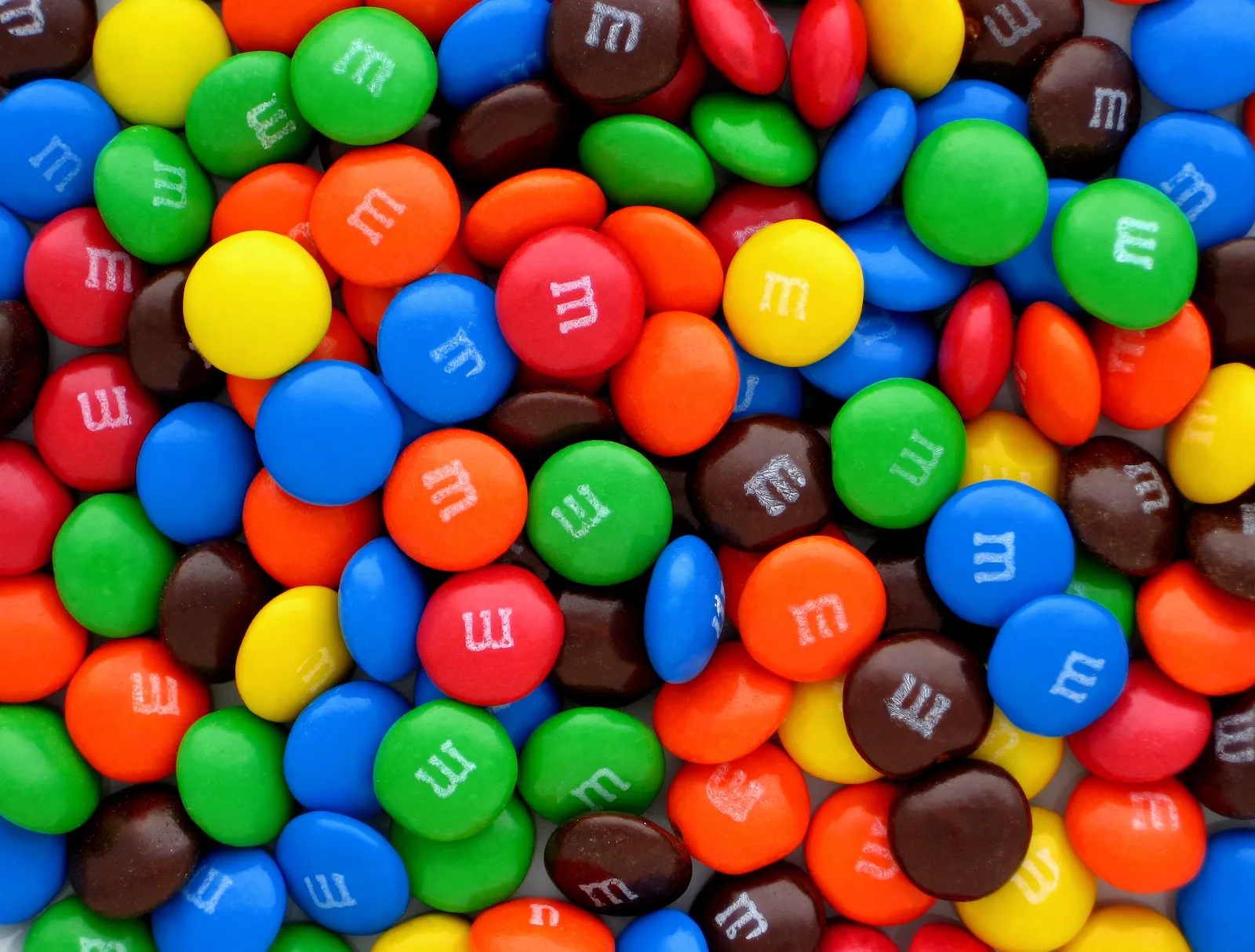
The rainbow in a bag of M&M's has barely changed since 1941. Starting in August, it will — and two familiar colors are sitting the launch out.
A dye-free debut, minus two colors
Mars plans to roll out M&M's made entirely without petroleum-based synthetic dyes in time for the brand's 85th anniversary, Fox Business reported, part of a broader reformulation that also covers Skittles, Starburst and Extra gum. Red, yellow, green and orange are in. Blue and brown are not — for now. "You're messing with an 85-year-old icon," said Anton Vincent, president of Mars Wrigley North America.
The blue problem
Swapping artificial dyes for natural ones is straightforward until you reach blue — the rarest stable color in nature. Mars has been working with spirulina, a pigment from blue-green algae, but at the concentrations needed for vivid candy shells it grows thick enough to clog factory spray nozzles and leave film inside equipment, and it is far costlier than common natural dyes — food-grade spirulina concentrate can top $100 a pound, versus roughly $10 for turmeric. Brown poses a related challenge: matching the chocolate-shell shade from natural sources without affecting flavor or stability. Mars says it has put more than 100 staff on the problem and expects all six colors back, in natural form, by 2028.
Washington's push
Mars isn't acting alone. The reformulation comes amid a federal drive to purge petroleum-derived colorants from the food supply: the FDA and HHS announced a plan to phase out nine synthetic dyes — including Red 40, Yellow 5 and 6, and Blue 1 and 2 — by the end of 2026, part of the "Make America Healthy Again" agenda championed by HHS Secretary Robert F. Kennedy Jr.; Red 3 was revoked in early 2025. Regulators cite long-running consumer and scientific concern about the dyes' effects, especially on children, a question advocates and industry have debated for years.
An industry-wide shift
Mars is one of the more visible names committing publicly, but not the only one. General Mills and Kraft Heinz have pledged to strip artificial dyes from U.S. products by the end of 2027, and PepsiCo has begun phasing them out of some snacks. The FDA has been tracking company pledges publicly, ratcheting up pressure on holdouts.
What shoppers will see
The August launch will be the first real-world test of whether natural dyes can match the vivid colors and familiar taste that made M&M's a best-seller — and natural pigments are generally less stable and pricier as the whole industry competes for the same beets, turmeric and algae. Blue M&M's, the color a fan vote added to the lineup in 1995, will be missing until at least 2028. Mars insists the color isn't retired — only delayed.