
The two forecasts this weekend point in opposite directions, and the collision between them is the story.
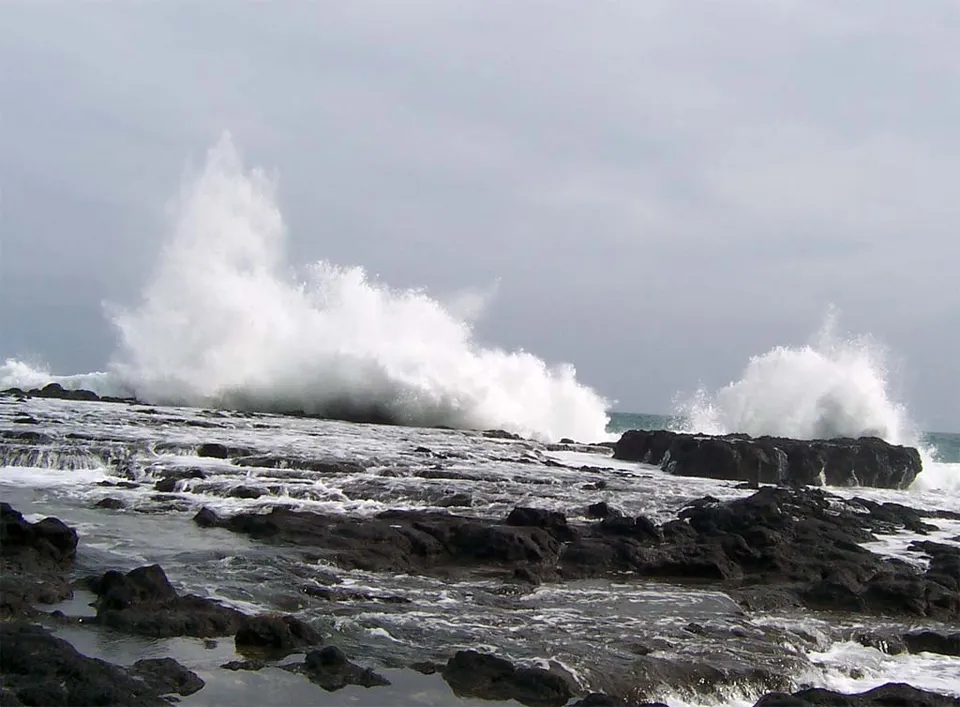
Inland, an extreme heat warning runs from Friday morning through Sunday evening, with valleys and the Inland Empire well past 100 degrees. At the coast, a swell generated by Hurricane Genevieve is driving waves to about 10 feet along roughly 700 miles of California coastline, from Ventura County through Los Angeles County and into Orange County.
One forecast sends people to the water. The other makes the water dangerous.
What the lifeguards are seeing
Los Angeles County officials say that this week, every lifeguard on duty has been averaging two to three water rescues per shift, with hundreds of rescues across the county daily. That is before a weekend in which the inland temperature gives several million people a reason to drive to the beach.
The hazard in a swell like this is not mainly the height of the wave. It is the rip current: a narrow channel of water moving fast back out to sea, usually between two zones of breaking surf, often invisible from the sand. It carries strong swimmers as easily as weak ones, and the danger comes from the instinct to swim straight back toward the beach, which means swimming directly against it until you are exhausted.
The county's guidance is the standard one and it works: swim parallel to the shoreline until you are out of the current, then angle back toward shore.
The other things a big swell does
Two hazards that catch people who never intended to swim.
The first is being swept off rocks and jetties. A set wave arriving larger than the ones before it will reach places that have been dry all afternoon, and people standing on a jetty to take a photograph are standing exactly where that happens.
The second is the sneaker wave, which is the same phenomenon on a beach: a wave that runs much further up the sand than its predecessors, takes an adult off their feet, and pulls them back down the slope. Small children playing at the waterline are the ones this reaches first.
South and southwest-facing beaches take the brunt of a southern swell, which in this region means much of the Malibu coast, the South Bay and the Orange County beaches.
The practical version
If you are going to the coast this weekend, swim near a staffed lifeguard tower and nowhere else, keep children within arm's reach at the waterline, stay off wet rocks and jetties, and do not turn your back on the water.
If the point of the trip is to escape the heat rather than to swim, the county's cooling centers, libraries and pools are open and are not being run by the Pacific. Details are at ready.lacounty.gov/heat, or by calling 2-1-1.