There is an argument running through film culture right now about how movies ought to be shown, and it is usually conducted in terms of format size. Christopher Nolan's "The Odyssey" has revived it, as his films tend to, by being exhibited in 70mm on the limited number of screens still able to handle it.
Joe Rinaudo's answer to the same question is smaller, older and considerably stranger. He runs film through a Power's Motion Picture Machine Model 6, built in 1909, and he powers it with his arm.
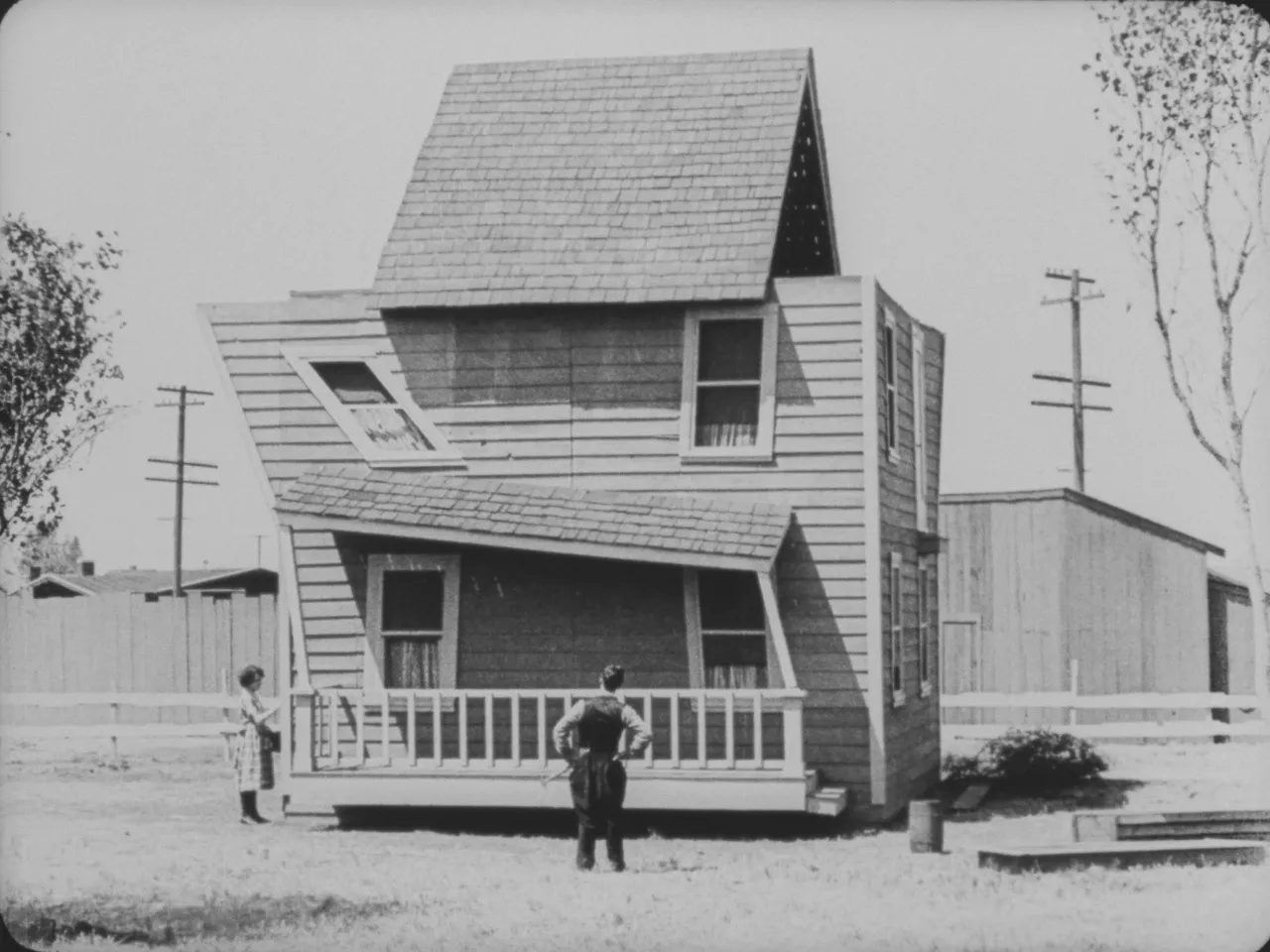
On Saturday at 8 p.m., he brings it to Two Strike Park at 5107 Rosemont Ave. in La Crescenta. The program is three shorts: Buster Keaton's "One Week" (1920), Charley Chase's "Crazy Like a Fox" (1926), and Laurel and Hardy's "Do Detectives Think?" (1927). Admission is free.
The crank is the point
Hand-cranked projection is not a gimmick layered onto the screening. It is the technology these films were made for, and it puts a person inside the performance in a way no modern format does. Silent films were not shot at a fixed frame rate. The camera operator cranked, the projectionist cranked, and matching the two was a skill.
Rinaudo describes it as a matter of watching the image rather than the machine. "You have to crank at the camera man's speed," he told LAist. "You have to watch the action very closely … If it slows down, and it looks blurry then you need to speed up, because you'll betray the camera man's shutter."
That is a real constraint, and it means every screening differs slightly from the last. A tired arm changes the comedy's timing. There is no way to pause and no way to skip. Whatever the audience gets is what the projectionist produces in that hour, which is closer to live music than to playback.
A projector from a chicken coop
The Model 6 came to him by an unlikely route. "I bought it from the great-grandchildren of the original owner," he said. "It was found in a chicken coop and [I] did a total restoration."
At home in La Crescenta he has built a 20-seat theater in the style of 1910, down to a red curtain and ornate period light fixtures he manufactured himself. He is also restoring an 11-rank Wurlitzer organ built in 1920 and salvaged from the Covell Theater in Modesto. Organs of that kind existed to give silent films their sound, supplying score, percussion and effects from a single console, and finishing it would let the theater run a program the way one would have been run when these comedies were new.
He has founded a nonprofit, Silent Cinema Art and Technology, to outlast him. "Eventually, all of this will go into the non-profit after my passing," he said. "I'm hoping to keep this as a private museum ... that will continue to educate and inspire younger people about our history."
Why it belongs here
Los Angeles built the industry that made these films, which makes the city an odd place for their exhibition technology to have become a specialty interest. Institutional preservation work continues at the Academy and the archives, and it is serious and well funded. But preserving a print is not the same as preserving the act of showing it. The knowledge of how to run a 1909 machine at the right speed lives in a very small number of hands.
Saturday's screening is a park event with a picnic-blanket audience, not a symposium. Keaton's "One Week," in which a newlywed assembles a build-it-yourself house from mislabeled instructions, remains one of the funniest two reels ever shot, and it does not require any of this context to work. That is rather the point. The films are still good. The unusual part is only that someone is standing behind the projector, turning it.