


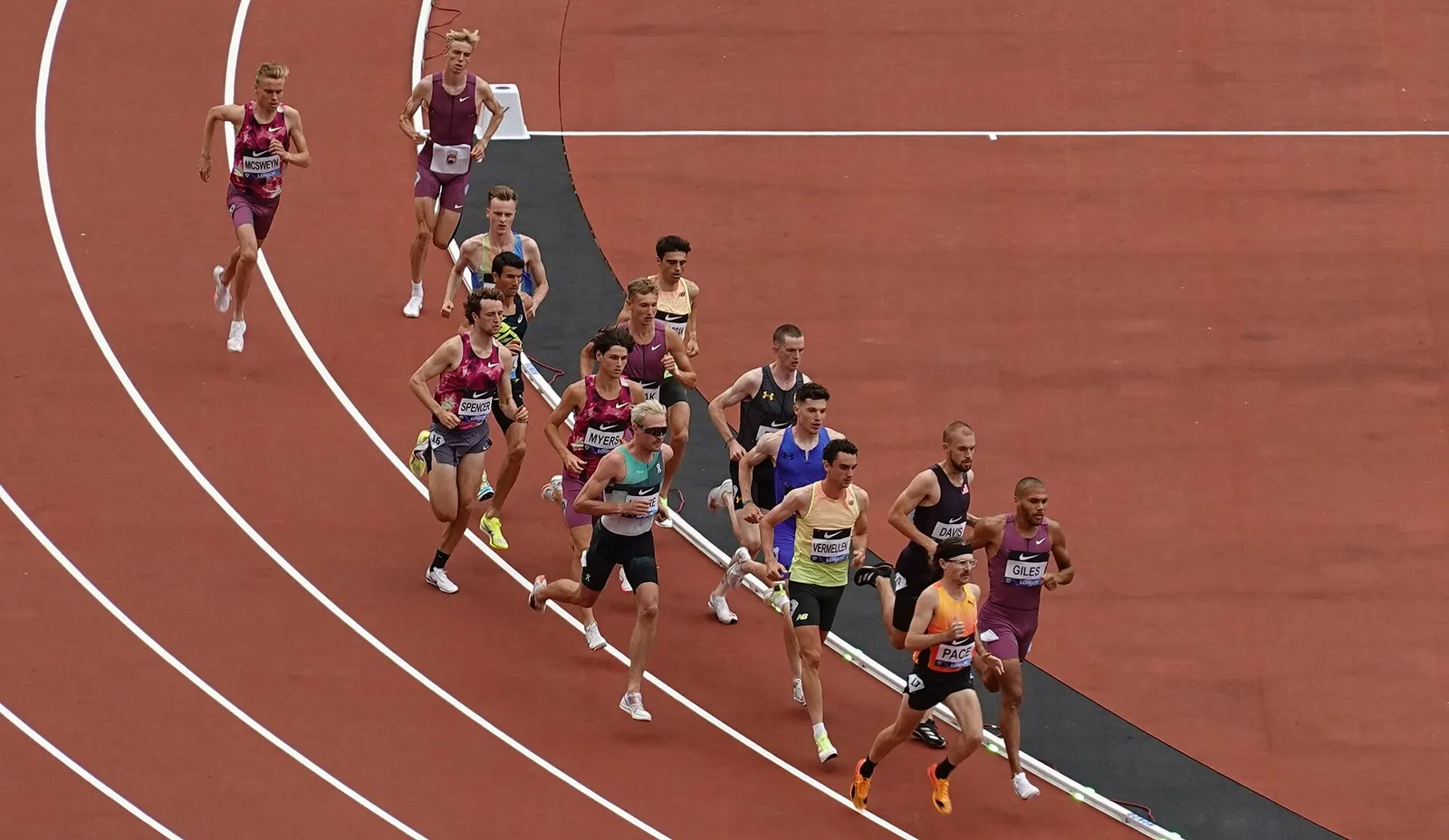
Some records fall by hundredths after years of pressure. This one fell by nearly half a second, in front of a home crowd, on a night everyone knew what was being attempted.
Josh Kerr ran 3 minutes 42.66 seconds for the mile at London Stadium on Saturday, erasing a world record that had stood since 1999 and becoming the first man to run under 3:43.
The mark he took down belonged to Hicham El Guerrouj, whose 3:43.13 in Rome had survived 27 years and an entire generation of milers. Kerr improved it by 0.47 seconds, which at this level is not a trim but a demolition.
The race
Kerr, 28, had made no secret of the attempt. He had announced the plan and given it a name, "Project 222," after the number of seconds he was chasing, and he ran into the meet carrying the weight of having said so out loud.
The margin behind him tells the story of the effort. American Yared Nuguse finished second in 3:45.69, more than three seconds adrift, with Britain's Jake Heyward third in 3:46.73. In a race where the winner breaks a world record, second place three seconds back is less a defeat than a measurement.
Afterward Kerr described the noise more than the running. "The last lap was incredible," he said. "I was deaf in the last 110 metres." On the buildup and the attention that came with announcing his intentions, he said simply: "It is very overwhelming. There was a lot of hype."
He also framed the result as the product of a program rather than a night. "I am surrounded by amazing people, so I have continued to put the work in and I knew I had a 3:42 in me," he said.
What the record means
The mile occupies an odd position in modern athletics. It is not an Olympic distance, having long since given way to the metric 1500 meters, and it appears on the championship program nowhere that matters most. Yet it remains the event with the deepest hold on the public imagination, the one distance a non-specialist can name a barrier for. That is Roger Bannister's legacy, and it is why a mile record still travels beyond the sport's own audience in a way a 1500-meter mark does not.
El Guerrouj's durability at both distances is part of the context for what Kerr has done. The Moroccan also holds the 1500-meter world record, and his mile mark had outlasted the careers of nearly everyone who chased it. Records that survive that long tend to acquire an air of permanence, which is usually an illusion and occasionally not.
Kerr's run returns the mile record to Britain, a country with an unusual claim on the event, from Bannister's first sub-four in 1954 through the Coe, Ovett and Cram years when British middle-distance running set the terms for everyone else.
Ahead
The immediate question is whether the barrier just broken proves to be a floor or a doorway. Marks that stand for decades often fall more than once in short order, as the field's sense of what is possible resets. Nuguse's 3:45.69 on a night he was beaten badly suggests the depth is there.
For Los Angeles, the longer arc points to 2028, when the Olympics arrive here. The mile will not be on that program, but the 1500 meters will be, and the man who just ran the fastest mile in history will have a claim on the city's attention when it is.