

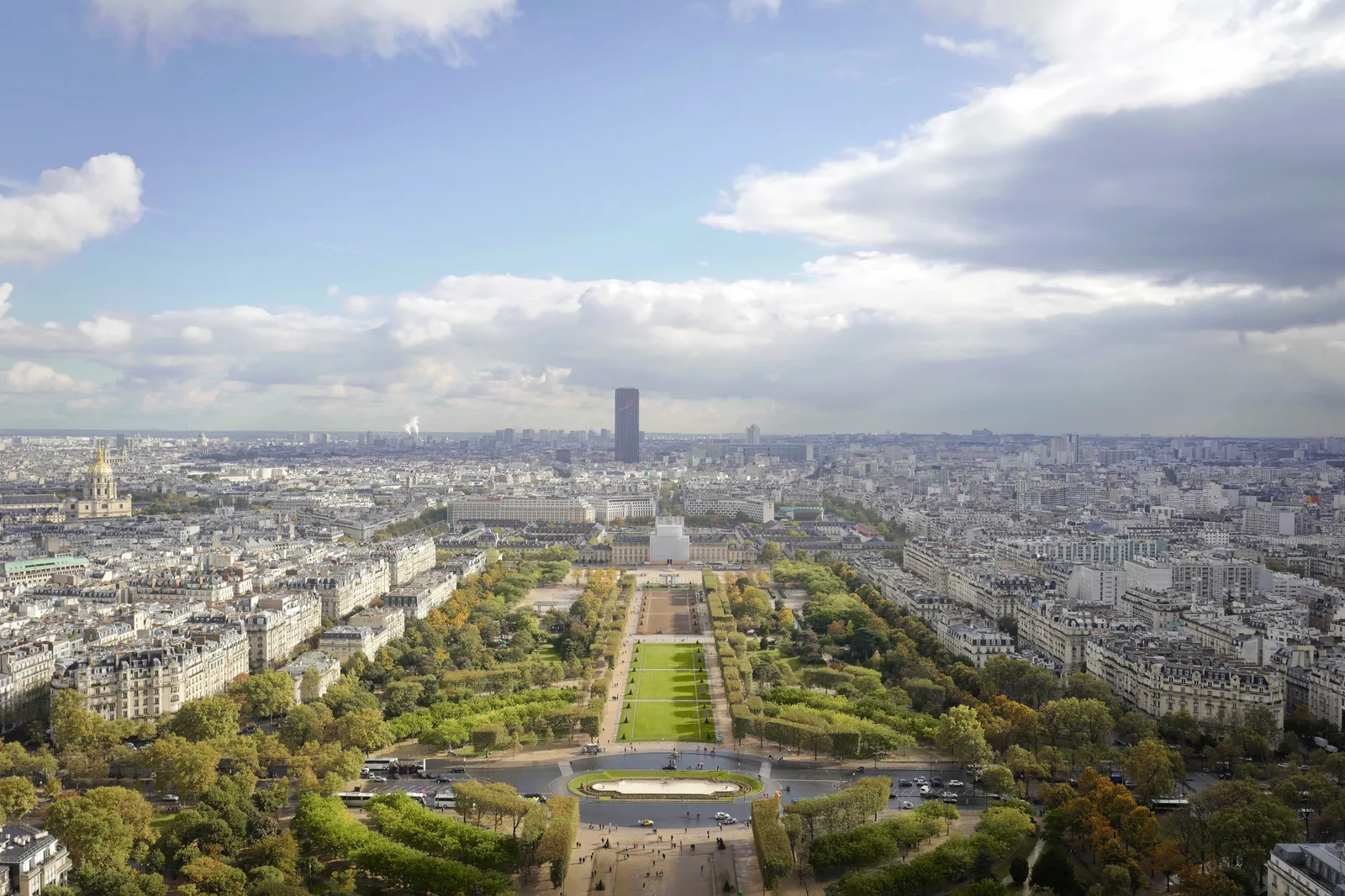
When a Paris storm flashes at the tip of the Eiffel Tower, it can look alarming. It is, in fact, the tower doing precisely what it was built to do.
A magnet in the sky
On June 27, severe thunderstorms behind a Paris heat wave delivered nearly 2,000 lightning strikes across the Île-de-France region in a matter of hours — and cameras caught the familiar blinding flash at the summit. That is no coincidence. At roughly 330 meters with its antennas, the tower is the tallest object in central Paris, and lightning is an exercise in efficiency: a thundercloud builds an enormous charge, and an ionized channel snakes downward seeking the lowest-resistance path to ground. A 7,300-tonne iron lattice three football fields tall is a very persuasive target.
By the tower's own records, it is struck about five times a year on average — more in stormy years — and has absorbed hundreds of strikes since 1889 without ever injuring a visitor.
Iron, physics and a very good ground
When lightning meets the tip, a return stroke surges back up the channel carrying tens of thousands of amperes; the whole flash lasts a fraction of a second. What keeps it harmless is engineering. Gustave Eiffel fitted copper lightning rods at the summit, connected by cables running the full height to grounding points buried beneath the four pillars. Tests in 1889 measured the tower's resistance to ground at a fraction of an ohm — so low that current flows almost without friction from sky to earth.
The lattice itself helps, too: the open iron framework acts as a giant Faraday cage, routing the charge along its outer surface rather than through any interior space, the same way a car's metal body protects passengers. An account from the tower's first summer in 1889 describes the structure ringing "like a tuning fork" after a strike, with droplets of iron briefly melted from the rod's tip by the surge.
Eiffel's hidden agenda: make it a laboratory
Eiffel knew his tower faced demolition when its 20-year concession expired, and his survival strategy was to make it scientifically indispensable. He installed a summit weather station and published daily readings at his own expense, ran aerodynamic drop experiments down its height, and later built a wind tunnel at its base that tested designs for early aviation. His scientific commission had argued from the start that a well-grounded 300-meter tower would act as "a huge lightning rod protecting a very large space around it" — a reputation Eiffel used to help win the renewal that saved the structure.
What researchers watch today
Modern lightning science distinguishes the classic downward cloud-to-ground bolt from upward lightning, in which a tall structure launches its own ionized leader toward a charged cloud — a phenomenon especially common at structures above about 100 meters. The tower's operator maintains strike counters and surge protection and checks its systems after big storms, turning each lightning bolt into another data point in a natural experiment more than a century long.
For Parisians watching from a café terrace, the takeaway is reassuring: the flash is not the tower in peril. It is the tower keeping everyone around it safe.